
Tactics training method
The Woodpecker Method, with the schedule kept for you
The Woodpecker Method is a way to train chess tactics by solving one fixed set of exercises again and again, in less time each round. ChessNam runs it as 7 cycles, keeps your clock and your score, and holds the rest day between cycles.
No account needed for the free exercises.
- cycles of the same set
- 7
- weeks if you hit every target
- ~9
- clear rest day between cycles
- 1
- exercises free to try
- 10
Where the method comes from
Strong players spot tactics fast because they have met the same patterns many times. Repeating one set, with less time each round, trains that recognition. Solving new puzzles forever mostly trains calculation.
The method comes from the book The Woodpecker Method by GM Axel Smith and GM Hans Tikkanen (Quality Chess, 2018). Get the book for the full method and the authors' own exercises.ChessNam is not affiliated with or endorsed by the authors or the publisher.
The 7-cycle Woodpecker schedule
- 28dCycle 1
- 14dCycle 2
- 7dCycle 3
- 4dCycle 4
- 2dCycle 5
- 1dCycle 6
- 1dCycle 7
| Cycle | Target | Beginner set (480) | Intermediate or Advanced set (530) |
|---|---|---|---|
| 1 | 28 days | about 17 | about 19 |
| 2 | 14 days | about 34 | about 38 |
| 3 | 7 days | about 69 | about 76 |
| 4 | 4 days | 120 | about 133 |
| 5 | 2 days | 240 | 265 |
| 6 | 1 day | 480 | 530 |
| 7 | 1 day | 480 | 530 |
Targets add up to 57 days of solving plus 6 rest days, about 9 weeks. The later cycles look heavy on paper, but by then you have seen every exercise several times.
How the Woodpecker Method works, cycle by cycle
- Cycles 1–3
Accuracy
Take your time. Miss one and you see the solution, then play it yourself before moving on.
- Cycles 4–5
Speed
A miss gets a quick review and you keep going. You are aiming for half your last time.
- Cycles 6–7
Full speed
No reviews. Each exercise moves straight to the next, the whole set in a day.
- One attempt per exercise. No hints and no instant answer. You commit to a move.
- Only thinking time counts. The clock stops when you answer, so reviewing costs you nothing.
- One clear day of rest. The next cycle opens after a full day off, so the patterns settle.
- Time and score every cycle. The summary shows both next to your last cycle.
Track your Woodpecker progress, cycle after cycle
The method only works if each cycle gets faster and more accurate. On paper you keep that record yourself. ChessNam keeps it for you and shows it after every session.
Jameshwart LopezTactical Motifs: Advanced · training, cycle 4Example
Cycle history
Rank #2 in the course- Position
- 403 / 530
- Accuracy (this cycle)
- 93%
- Cycles done
- 3
- Best cycle
- 4h 04m
- 18h 50m69%
- 25h 08m76%
- 34h 04m83%
- 41h 26m93% so far
Daily activity
Last 30 days- Days trained
- 22 of 30
- Exercises per day
- 73
- Time per day
- 38m
- Current streak
- 2 days
- Cycle progress
- Where you are in the set, and how many cycles are done.
- Accuracy
- Exercises fully solved this cycle, compared with the last one.
- Best cycle
- Your fastest full run through the set.
- Daily activity
- Days trained, exercises and time per day, and your streak.
- Standings
- Your rank among everyone training the same course.
- Missed exercises
- A list of the ones you got wrong, to study between cycles.
You find all of this on the course page once you own the course: open your own row on the leaderboard.
Is the Woodpecker Method for you?
A good fit if you
- miss tactics in games that you would solve as a puzzle
- can train most days for about two months
- like seeing your own times and scores improve
Probably not if you
- want new puzzles every day
- can only train now and then
- want hints while you solve
What ChessNam does differently from the book
- The exercises
- We do not use the book's exercises. Ours come from the open Lichess puzzle database, grouped by tactical theme and ordered easiest first.
- Time targets
- You do not have to plan them. ChessNam sets each cycle's target from your own time in the last one.
- Rest days
- The rest day is built in. The next cycle stays locked until it has passed.
- Finishing early
- From cycle 2, if you solve the whole set in a single day, the programme ends there. The set is learned.
- Scoring
- You get a point for the first move and a point for each key move after it, in every cycle.
Woodpecker Method courses on ChessNam
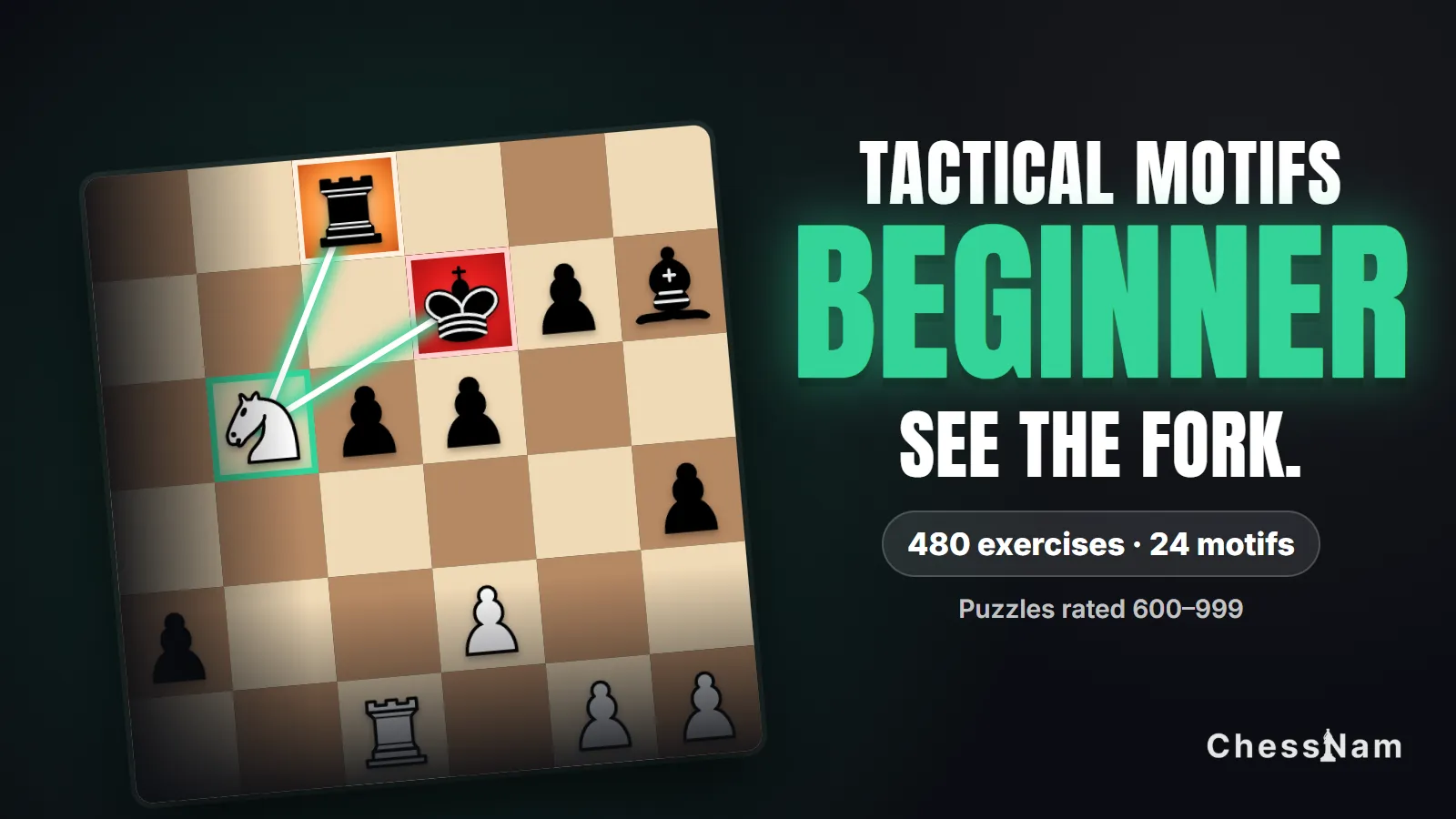 TacticsBeginner · Woodpecker
Tactical Motifs for Beginners
Your child knows how the pieces move. This course teaches them to see what the pieces can do. 480 exercises from the Lichess puzzle database, rated 600 to 999, sorted into 24 tactical motifs: forks, pins, skewers, discovered attacks, deflection, zugzwang and more, 20 exercises each with a plain-language explanation of the pattern. Every exercise is White to move, so there is nothing to get used to except the idea. Train it the Woodpecker way: solve the whole set, then solve it again faster, until spotting a fork takes no thinking at all. The first 10 exercises are free. Built by a chess dad for his own son — he's training on it now.
480 exercises · 10 free to try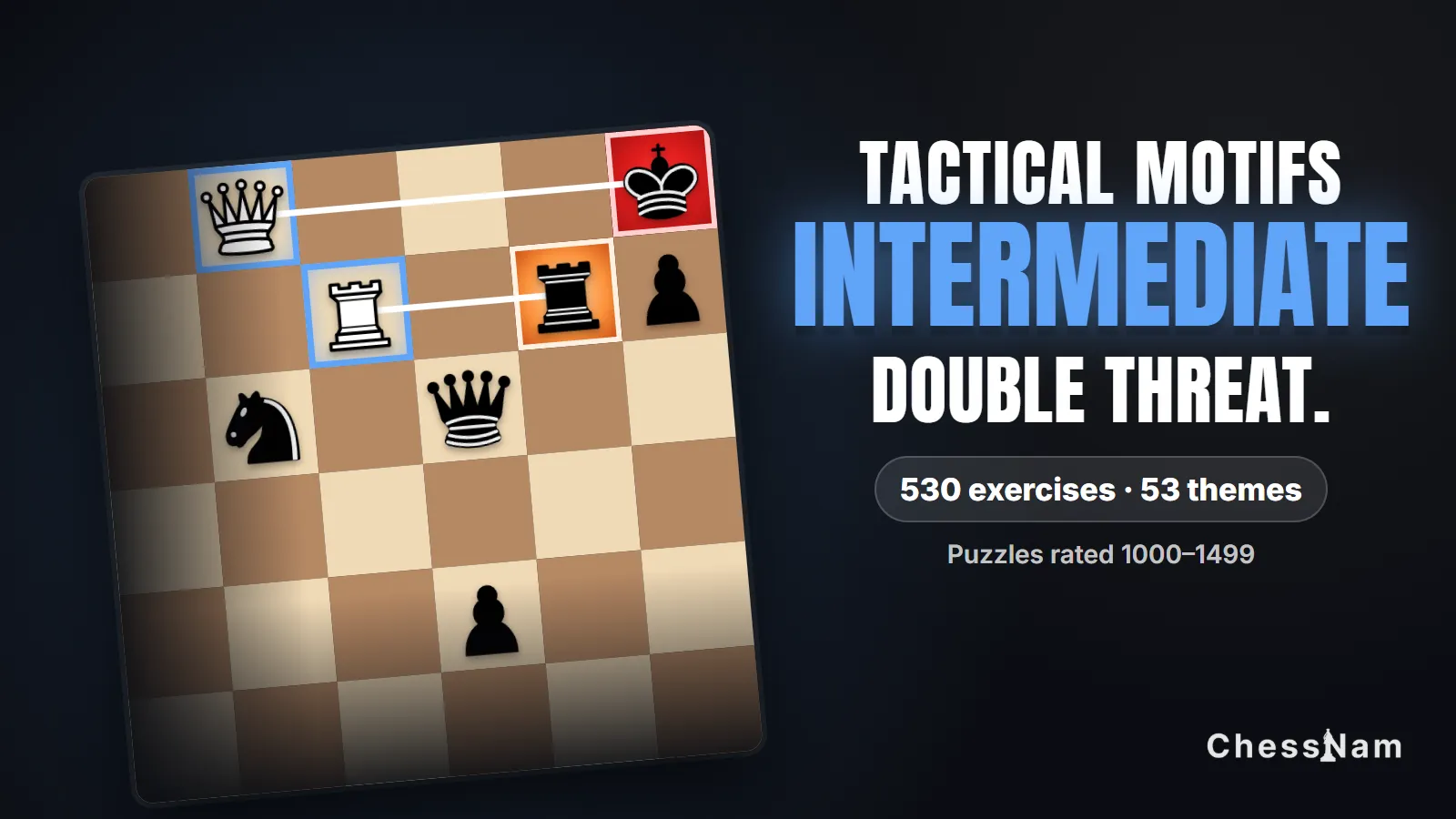 TacticsIntermediate · Woodpecker
Tactical Motifs: Intermediate
Built for club juniors and adult improvers rated around 1000 to 1500 who see the tactic after the game instead of during it. 530 exercises from the Lichess puzzle database, rated 1000 to 1499, covering all 53 tactical themes: every motif, special move and checkmate pattern, plus mate in 1 to 5. Ten exercises per theme, grouped so each pattern sinks in before the next one starts. Every exercise is White to move and carries a short explanation of the idea. Train it the Woodpecker way: solve the set, then solve it again faster, until the patterns show up on their own in a real game. The first 10 exercises are free.
530 exercises · 10 free to try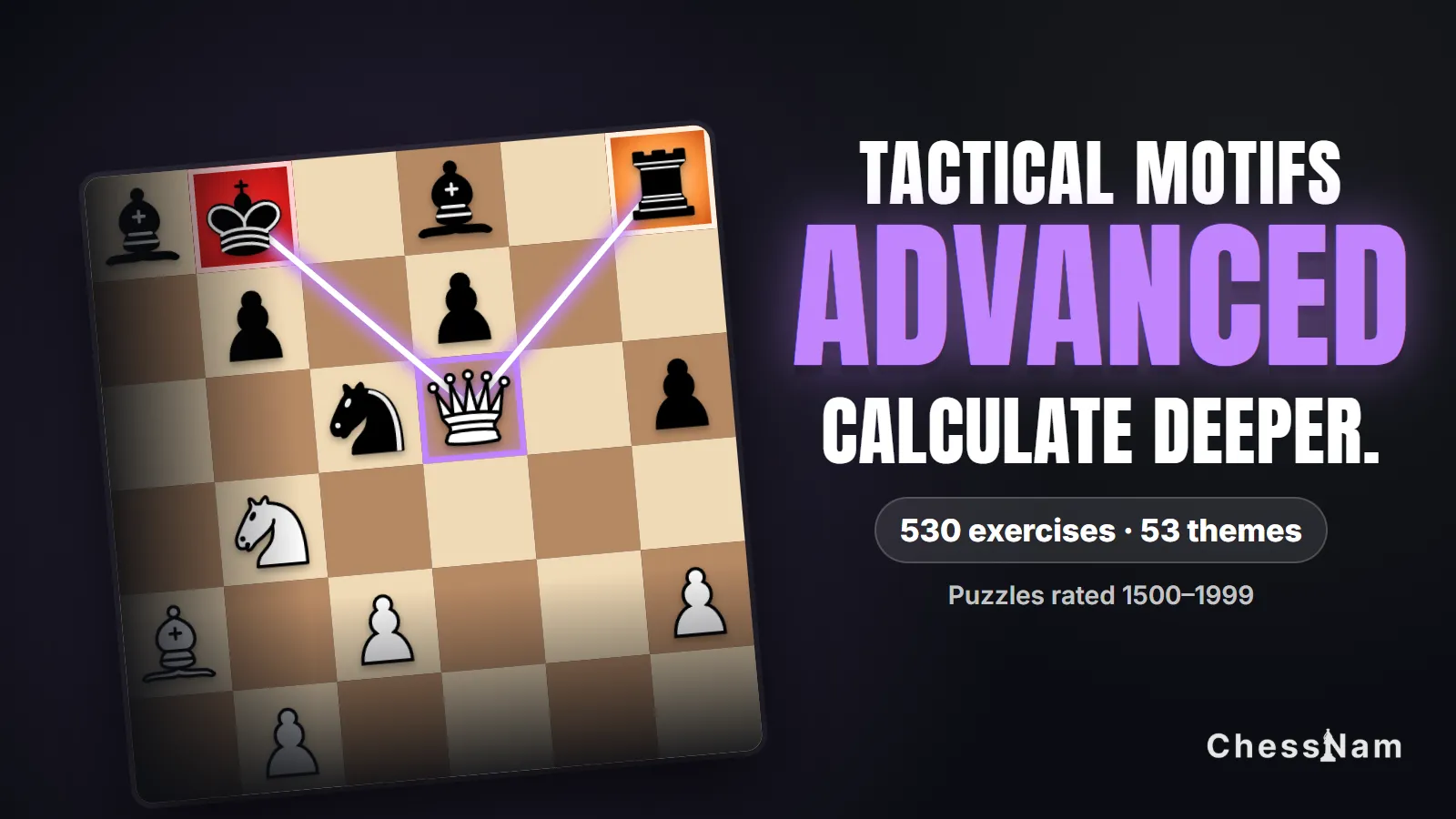 TacticsAdvanced · Woodpecker
Tactical Motifs: Advanced
For rated players stuck between 1500 and 2000 who calculate well but still miss the quiet move. 530 exercises from the Lichess puzzle database, rated 1500 to 1999, across all 53 tactical themes, from interference and zugzwang to Anastasia's mate and mate in 5. Ten exercises per theme, sorted easiest first, every one White to move with the pattern named and explained. Train it the Woodpecker way: full set, then again on the clock, until the hard motifs come as fast as the forks. The first 10 exercises are free.
530 exercises · 10 free to try
One-time purchase, yours to keep. See all courses
Woodpecker Method questions
ChessNam runs it in your browser, on a phone or a computer, with nothing to install. It keeps the set, the cycles, the clock and the rest days for you.
Yes. Our courses are built that way: each one is a fixed set chosen from the open Lichess puzzle database, so every cycle has the same exercises.
In cycle 1, about 17 to 19 a day for our sets. The number roughly doubles each cycle because the target days halve. The schedule table on this page has every cycle.
Nothing locks and nothing resets. The day targets are goals. Pick up where you stopped.
There is one clear day of rest between cycles. A cycle finished on Monday opens the next one on Wednesday, Philippine time.
From cycle 2, a cycle that starts and ends on the same day means you know the set. The programme ends there.
Play rated games and use the patterns. Rest from puzzle sets for a few weeks. Then run the same set again, about six weeks later.
No. It is ChessNam's own training, built on the method described in the book, with different exercises. The authors and publisher are not involved.
Start with 10 free exercises
Pick your level and solve the first ten. No account needed.